Set.js
#Passionate MERN Stack Web Developer.
I am a dedicated web developer with a passion for creating interactive and engaging user experiences. I specialize in the MERN Stack, which is a powerful combination of JavaScript technologies that empowers me to build full-stack web applications.
My expertise lies in utilizing MongoDB for data storage, Express.js for backend development, React.js for dynamic frontends, and Node.js for server-side scripting. I am also proficient in HTML, CSS, and JavaScript frameworks such as Bootstrap and jQuery.
Through my blog on Hashnode, I strive to share my knowledge and insights with fellow developers, aspiring to contribute to the growth and vibrancy of the web development community. I aim to provide comprehensive tutorials, practical tips, and insightful discussions on various aspects of MERN Stack development.
Whether you're a seasoned developer or a budding enthusiast, I invite you to join me on this journey of exploring and mastering the MERN Stack. Together, let's harness the power of these technologies to build innovative and impactful web applications.
#Key Skills:
->MERN Stack (MongoDB, Express.js, React.js, Node.js) ->HTML, CSS, JavaScript ->Bootstrap, jQuery
Areas of Expertise:
->Full-stack web development ->Interactive user interfaces ->Data-driven web applications ->Cross-platform compatibility ->Responsive and mobile-friendly design
#My Mission:
-> To empower fellow developers through knowledge sharing ->To contribute to the MERN Stack community ->To build innovative and impactful web applications ->To foster a collaborative and learning-oriented environment ->To inspire and motivate aspiring web developers
I welcome your feedback, questions, and engagement. Let's connect and embark on this exciting journey of web development together!
by Dinkar Thakur...
Set in Javascript!
Sets in JavaScript
Sets are a collection of unique values. They can contain values of any type, including primitives, objects, and functions. Sets are iterable, meaning that you can iterate over the values in a set in a specific order.
Sets are a relatively new data structure in JavaScript, having been introduced in ES6. However, they have quickly become popular due to their efficiency and ease of use.
One of the biggest advantages of sets is that they are implemented using a hash table. This means that adding, removing, and checking for membership in a set are all very efficient operations.
Another advantage of sets is that they only allow unique values. This can be helpful for avoiding duplicate data, and it can also make it easier to find the union or intersection of two sets.
Finally, sets are iterable, meaning that you can easily iterate over the values in a set. This can be useful for tasks such as printing the values in a set to the console or performing operations on each value in a set.
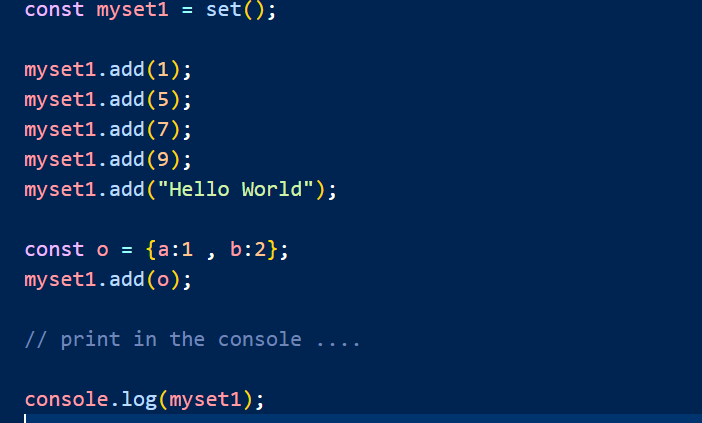
Here are some examples of how to use sets in JavaScript:
JavaScript
// Create a new set from an array of strings:
const colors = new Set(['red', 'green', 'blue']);

// Add an element to the set:
colors.add('yellow');

// Remove an element from the set:
colors.delete('blue');

// Check if a value is in the set:
if (colors.has('green')) {
  console.log('The color green is in the set.');
}

// Iterate over the values in the set:
for (const color of colors) {
  console.log(color);
}
Sets are a powerful and versatile data structure that can be used in a variety of applications. If you are working with JavaScript, I encourage you to learn more about sets and how to use them.
For any help and if you have any second thoughts then u can connect me on GitHub
and Instagram.
I hope this is helpful to understand the Basic of Set method of #javascript!